Image
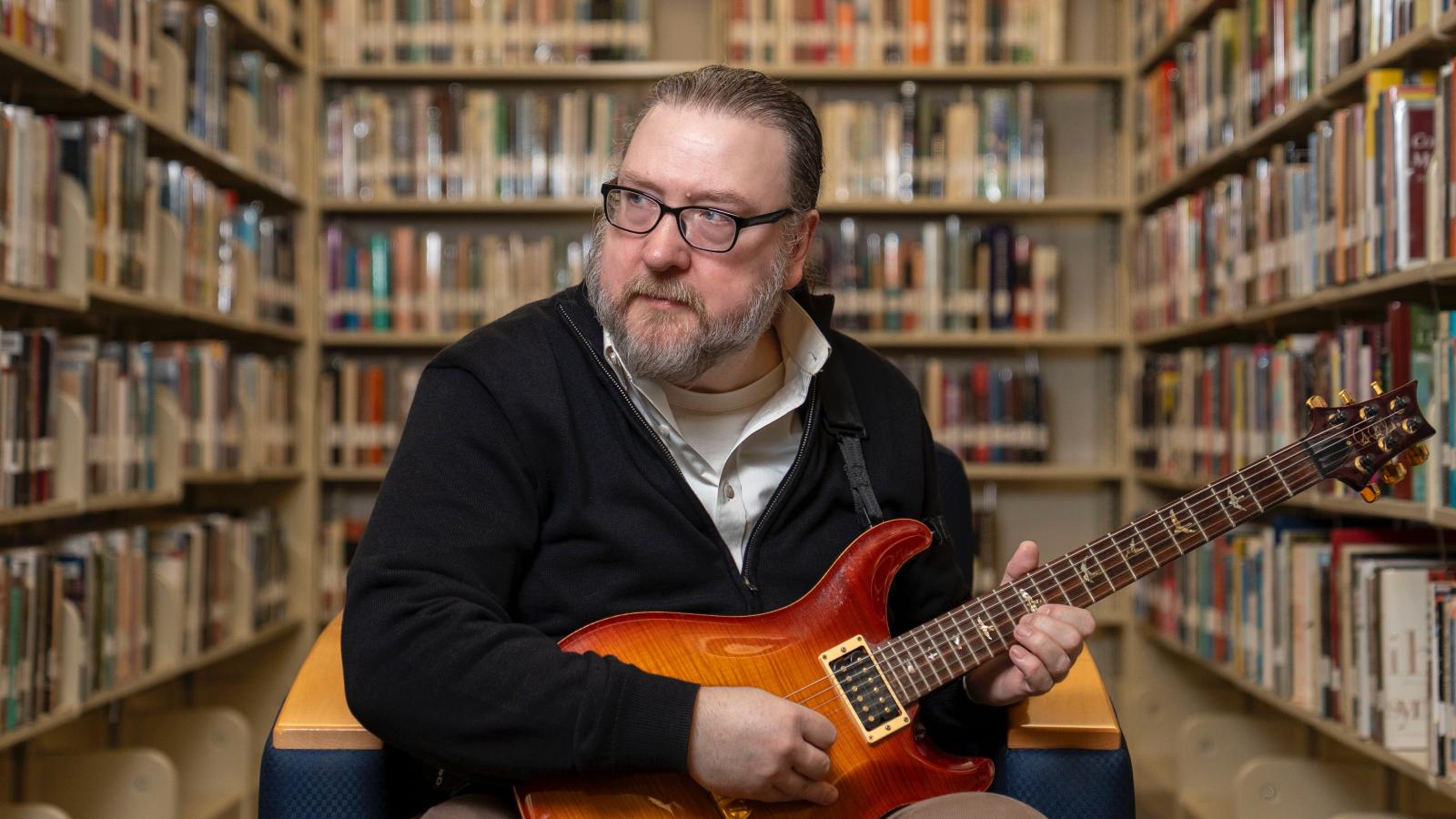
There is a specific frequency associated with libraries. It is a low hum, composed of turning pages, the soft click of keyboards, and the ventilation system working to preserve physical collections. It is a world designed for the quiet absorption of knowledge.
Rand Bellavia is the guardian of this silence. As the Director of the Library at D'Youville University, he is responsible for the study spaces, the digital archives, and the “boots on the ground” work of the librarians. He ensures the building is a sanctuary available 24/7 for students seeking a quiet corner.
But 10 to 12 weekends a year, Bellavia trades the silence for a wall of sound. He swaps the Dewey Decimal System for a PA system, standing in front of crowds in Portland, Columbus, London, or Germany, waiting for the applause to die down so he can sing a song about Aquaman.
“I like that I get to kind of pretend I'm a rock star,” Bellavia says.
The Signal-to-Noise Ratio
Bellavia holds a master’s in theological studies and library science, yet his musical career is built on the bedrock of “nerd culture.” He is a pioneer of “Filk”, a musical genre born from science fiction and fantasy fandom, and a founding member of the band Ookla the Mok.
For Bellavia, the distance between managing a library collection and managing a setlist isn't as far as one might think. Both require a keen understanding of what he calls the “signal-to-noise ratio.”
“In collection development, if you have a collection of 100 books and 30 of them are circulated, and you remove the 70 that haven't circulated, the circulation of those 30 goes up,” Bellavia explains. “Having a better signal-to-noise ratio is going to be better... sometimes having 75 different brands of chocolate chip cookies is not helpful.”
He applies a similar philosophy to his music. For his band, Ookla the Mok, He doesn't write about his own life; he writes about fiction. He uses metaphors cloaked in pop culture references, Star Trek, Mr. Potato Head, comic books, to invite listeners in rather than gatekeep them out.
“I approach songwriting in terms of the craft,” he says. “I want to develop a strong melody and an interesting chord progression. It's not that my songs never say anything, but usually, if I'm saying something, it's through metaphor.”
Hidden Tracks
If you grew up in the mid-2000s, you have likely heard Bellavia’s voice, even if you’ve never stepped foot in his library.
He wrote and performed the theme song for the Disney cartoon Fillmore!. More surprisingly, his voice is the very first thing you hear on the Gym Class Heroes' massive hit, “Cupid’s Chokehold.”
“The producer of the album happens to be one of my best friends,” Bellavia recalls. “He called me up and said, ‘You want a piece of this?’”
Bellavia recorded vocals originally intended to support Patrick Stump of Fall Out Boy. When the song was remixed for a second album, all the instruments were replaced, but Bellavia's vocals were kept. “The first thing you hear on that song is my voice, isolated,” he laughs. “It's kind of a happenstance, really.”
Via Bella: Finding a New Voice
The duality of Bellavia’s life, the solitude of the stacks versus the spectacle of the stage, feeds a personality that he describes as a “weird” extrovert. Recently, his private creative process has evolved into a shared one with his wife, Erin, in a band cleverly named Via Bella, an anagram of his last name designed to help people pronounce it correctly.
The project’s origins are rooted in courage. “She was absolutely not a performer,” Bellavia says of Erin. “She had been told at a young age... that she did not have a good voice and that she should not sing.”
Bellavia calls that assessment “groundless.” A writer and journalist by trade, Erin began sharing lyrics with Rand, offering a fresh perspective to a songwriter with 35 years of experience. “I’ve been writing songs for 35 years... I got the craft part down, but I don’t always have ideas,” he admits. “She has a ton of really good ideas.”
The band’s reach exploded during the pandemic. During lockdown, the couple hosted weekly Zoom concerts to raise money for charity. “We didn't want to just be the guy distracting people from the serious stuff,” Bellavia explains. The virtual format accidentally allowed them to expand their reach, introducing Via Bella to audiences around the world who had never heard of them.
“That’s how we suddenly were performing in Germany,” he says, recalling a recent tour where audiences would offer “thunderous applause” for a full minute after a song ended.
Recently, Via Bella released a new EP, available in both digital and physical formats. In a twist of irony for a lyric-focused band, the standout hit has been an instrumental track Bellavia almost cut from the record. “It’s the most streamed thing so far,” he laughs. “We treat every idea like it's worth a million dollars because you don't get to decide which one is.”
Art Grows Your Soul
At the end of the day, whether he is weeding out unused books to make a collection shine or layering instruments in a recording studio, Bellavia operates under a single guiding principle, borrowed from Kurt Vonnegut: “Art grows your soul.”
“We are born wanting to sing and draw and run,” Bellavia muses. “As we get older, people tell us, ‘You don't do that very well,’ so we stop doing it. But I don't run well enough to participate professionally in athletics; that doesn't mean I should stop using my legs.”
For the students at D'Youville, Bellavia is the man ensuring they have the right resources to learn. But for the fans in a convention hall in Germany, cheering for an encore, he is proof that you don't have to choose between the silence and the sound. You just have to know when to play the right track.
Listen on Bandcamp:
https://viabellaband.bandcamp.com/